
29 May 2026
Breaking bread over breaking science
 NeuroWorks Fellows Kamila Maria Jozwik (left) and Lucy Jung (right) at the forefront of neurotechnology research.
What if we could prevent dementia before it occurs? What if we could build technologies that help the brain heal itself? What if some of the assumptions we have accepted for years in neurotechnology could actually be challenged?
These are the questions that our Activation Partner, Cambridge NeuroWorks (CNW) is looking to answer. CNW is a consortium of nine partners, convened by Cambridge University Health Partners (CUHP) bringing together leaders from science, health and business to support our Scalable Neural Interfaces opportunity space. They have built a programme that helps frontier neurotechnology ideas move rapidly from concept to treatments that can benefit patients.
Building a UK neurotechnology ecosystem
Neurotechnology has the potential to change the world, but turning breakthrough ideas into treatments is exceptionally challenging. Developing new treatments often means navigating clinical trials, regulation and commercialisation, while trying to bring together researchers, clinicians and industry partners across different fields. Many promising ideas stall before reaching patients because the pathway to translation is so fragmented. Our partnership with Cambridge NeuroWorks was designed to close that gap.
“ARIA’s investment in our unique model - fundamentally putting the strengths of Cambridge at the service of the entire UK - is making it more likely that we can tackle serious unmet neurological needs in unconventional ways and turn world-leading science into real-world impact, accelerating technologies and companies that can improve lives, strengthen the NHS, and build long-term value for the UK.” says Ahmed Akhbar, Cambridge NeuroWorks Programme Lead
Cambridge NeuroWorks runs two fellowship streams, the Blue Sky Fellowship and the Frontier Fellowship. These fellowships are complemented by two shorter programmes, ‘What If’ and ‘Proof of Concept’, and a concerted effort to build a vibrant UK neurotechnology Network. Their collective aim is to provide opportunities for testing and translating bold early-stage ideas in neurotechnology, targeting conditions including depression, stroke recovery, chronic pain, epilepsy and phantom limb pain.
Since launch, Cambridge NeuroWorks has seen demand for its programmes steadily increase, reaching over 15:1 application per place ratio, with significant applications and engagement coming from outside Cambridge and representation from all over the globe. Of the 17 fellows to date, 12 have been from outside Cambridge with a wide range of backgrounds, including corporate law, engineering, neuroscience and clinical research.
Cambridge NeuroWorks is creating an ecosystem for neurotechnology translation, a place where researchers, clinicians, founders, engineers, patients and commercial experts can come together around ambitious ideas that might otherwise struggle to find the right expertise and support. Spaces that combine all of these specialisms seamlessly in one place, are rare, particularly in neurotechnology, where progress is often dependent on close collaboration across multiple disciplines.
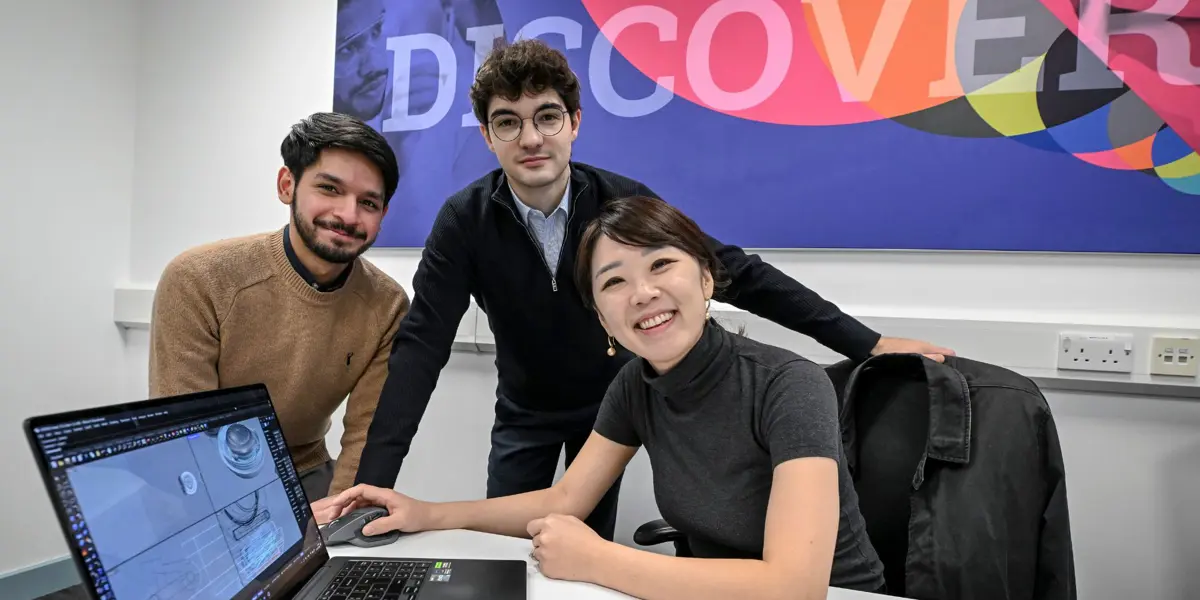
Image: Lucy Jung (front right), a Cambridge NeuroWorks Fellow, is working with LYEONS Neurotech to develop next-generation neurotechnology for brain health.
The Cambridge NeuroWorks Fellowships
The Cambridge NeuroWorks Fellowships have been designed to empower outstanding individuals with high-impact, highly speculative neurotechnology concepts that require the freedom to 'fail fast’ and retry. They are given the tools, networks and expertise to translate and accelerate bold ideas in neurotechnology towards patient-scale impact.
Just one year into the programme, they are already seeing progress, with the first six fellows having completed their fellowships. Each entered the programme with an emerging concept in neurotechnology from a device allowing recovering stroke patients to access physiotherapy remotely, to an accessible, affordable approach for diagnosing dementia. Within 12 months, all six had advanced their ideas ready to test on patients, demonstrating how rapidly innovation can move when researchers are given the right environment and infrastructure. Collectively, they’ve also raised over £2.4M in funding to continue developing their technologies beyond the fellowship.
For Lucy Jung, the Founder of LYEONS Neurotech, the fellowship helped turn a stripped proof of concept into a CE and UKCA-marked product, with preparation underway for regulatory certification. Her company is developing LYEONS Heart, a handheld device using adaptable, heartbeat-like sensory stimuli and a companion app to help users with mental health conditions to regulate their physiological state for rest or focus.
"We went from carrying out a literature review to preparing for a 100-unit production run,"
Lucy Jung
Founder of LYEONS Neurotech
Similarly, for Sam Kamali, the CEO of Myonerv, the fellowship has supported the development of a wearable neurostimulator designed to remotely monitor and treat stroke-induced paralysis. Early results have shown promising improvements due to precise, real-time stimulation tailored to each patient’s muscles. Sam’s team has been connected with clinical, academic and innovation partners, including stroke clubs and commercialisation advisers.
"The big benefit of CNW is the chance it gives you to connect into a larger UK ecosystem for technology incubators, clinicians, founders' mentorship, and additional funding,"
Sam Kamali
CEO of Myonerv
These stories show what can happen when you bring together research expertise, clinical insight, entrepreneurial support and translational infrastructure, to create a pathway where UK innovators can enter with an early-stage idea and leave with technology ready for testing.
The 'What If' Programme
The ‘What If’ programme which is a core component of CNW’s Blue Sky Fellowship, is designed to empower outstanding individuals to explore bold, high-impact neurotechnology ideas that may sit outside conventional funding and research pathways. It creates the space to explore speculative concepts rapidly, challenge assumptions, and pursue unconventional approaches with the freedom to fail fast, learn quickly, and iterate. By combining diverse expertise, structured challenge, and translational thinking from the outset, the programme aims to unlock ambitious ideas with the potential to address serious unmet neurological needs and catalyse entirely new directions in neurotechnology.
Proof of Concept Programme
Alongside its Fellowship programmes, Cambridge NeuroWorks is enabling ambitious experimentation sprints across the UK through its Proof of Concept (PoC) scheme. Designed to support adventurous, early-stage neurotechnology hypotheses, the programme recently selected eight “moonshot” projects from 154 applications. The PoC scheme allows anyone with a potentially transformative idea to rapidly test it through a focused six-month sprint - without the need to relocate to Cambridge or commit to any long-term career change. The programme embraces bold experimentation, recognising that disproven hypotheses, fast iteration, and strategic pivots are often essential to breakthrough innovation. Projects are hosted at UK universities and centres where local expertise, infrastructure, and translational support are best placed to help teams rigorously test their ideas.
A new pathway to commercialisation
To take breakthroughs from the bench to the bedside, Cambridge NeuroWorks has established a dedicated commercialisation pathway for neurotechnology innovators.
They’re building a multi-specialist hub to be a single ‘front door’ for researchers to connect with specialists across clinical translation, regulation, investment, product development and commercialisation. This integrated approach is designed to make it significantly easier for promising neurotechnology ideas to access fractional expertise in order to move beyond the lab and into the real world.
They’re building a multidisciplinary support hub to be a single ‘front door’ for researchers to connect with specialists across clinical translation, regulation, investment, product development and commercialisation. This integrated approach is designed to make it significantly easier for promising neurotechnology ideas to move beyond the lab and into the real world.
Want to get involved? On Monday 15 June in Cambridge, Cambridge NeuroWorks will bring together leaders from across the neurotechnology ecosystem for a flagship event focused on innovation, translation and transformative treatments. The event will explore how the UK can build a globally leading neurotechnology ecosystem. Learn more and sign up here.
Cambridge Neurowork’s partners: Babraham Research Campus | Cambridge Network | Cambridge Neuroscience | Cambridge University Health Partners | Cambridgeshire and Peterborough NHS Foundation Trust (CPFT) | Maxwell Centre | Milner Therapeutics Institute | University of Cambridge | Vellos